
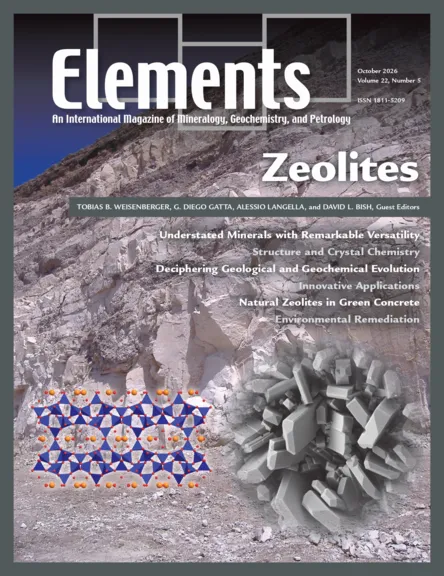
Zeolites are among the most versatile minerals in the Earth’s crust. These tectosilicates possess open-framework crystal structures containing interconnected channels and cages that accommodate H2O molecules and exchangeable cations. Their unique structures give rise to a remarkable range of properties, including reversible hydration and dehydration, ion-exchange capacity, and molecular sieving behavior. As a result, zeolites have attracted sustained interest from mineralogists, geochemists, materials scientists, and engineers for over a century. Natural zeolites form under relatively low-temperature conditions in diverse geological environments. Their occurrence provides valuable insights into fluid–rock interactions and the evolution of near-surface geological systems through space and time. In addition, their physicochemical characteristics make them important industrial minerals with an ever-increasing range of technological applications.
Geochemical Society members can access this issue now via the Elements website using your email address (UserID) and member number (Password).